The Install

Heat pump hot water is getting a lot more attention, and for good reason. With electricity costs rising and homeowners looking harder at where their energy goes, hot water is increasingly part of the conversation.
But while customers may understand the basic idea of a heat pump, the questions they ask tend to be much more practical.
Will it actually save me money? Will we run out of hot water? How long will it take to recover after everyone has had a shower? And what happens when it gets cold outside?
Here are five questions installers are likely to hear more often.
1. Are they actually worth it?
For households using a lot of hot water, the reduction in energy use can make a big difference. The real answer depends on household size, usage and what they’re replacing.
2. Will we run out of hot water?
Sizing matters. A correctly sized system needs to account for household demand, peak usage and recovery time, not just how many litres are printed on the cylinder.
3. How quickly do they recover?
Recovery is one of the biggest differences between heat pump hot water systems, and it’s not just about cylinder size. More on that below.
4. What happens when it’s cold?
Not all heat pumps perform the same way as outdoor temperatures drop. Check the operating range and performance data, particularly for colder parts of New Zealand.
5. Are they reliable?
Quality of equipment, correct sizing and installation all matter. As with any hot water system, choosing the cheapest box isn’t necessarily choosing the cheapest system over its lifetime.
How quickly will it recover?
This is where not all heat pump systems are equal.
Compact all-in-one units can be a great solution, but many have lower heating capacity than a dedicated external heat pump connected to a storage cylinder. That can mean longer recovery times after heavy hot water use.
A dedicated system can give the installer more flexibility around both heat pump capacity and cylinder size, which becomes important in larger households or homes with high peak demand.
For example, Waterware’s Ritter 5 kW direct hot water heat pump can produce around 100 litres of hot water per hour under rated conditions when heating water from 15°C to 55°C.
What size hot water cylinder do I need?
Choosing the right hot water system isn’t just about how many people live in the house.
What really matters is how much hot water the household uses at its busiest time.
Back-to-back showers, baths, teenagers, multiple bathrooms and morning routines can all change the amount of hot water a household needs.
With a Ritter split hot water system, the heat pump and cylinder are separate, so you can choose the amount of stored hot water that best suits the household.
A simple guide
180L ≈ 5 showers
👤👤👤👤👤
215L ≈ 6 showers
👤👤👤👤👤👤
250L ≈ 7 showers
👤👤👤👤👤👤👤
300L ≈ 8–9 showers
👤👤👤👤👤👤👤👤👤
(Based on approximately 35L of hot water per six-minute shower. Actual hot water use will vary.)
Need more hot water during a busy period?
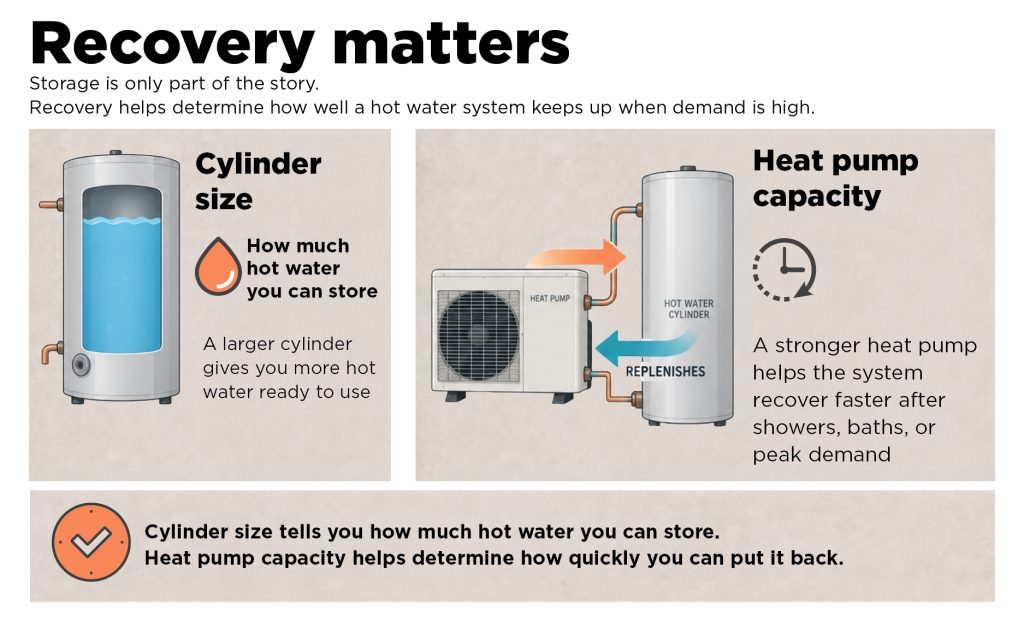
Storage gets you started. Recovery helps you keep going.
A bigger cylinder gives you more hot water ready to use. The other part of sizing is recovery.
Once hot water has been used, the heat pump needs to replace it. This is where heating capacity becomes important, particularly when several showers or baths happen close together.
Cylinder size tells you how much hot water you can store.
Heat pump capacity helps determine how quickly you can put it back.
Think about peak demand
When customers are choosing a cylinder, ask:
- How many people live in the home?
- How many showers could happen back-to-back?
- Is there a bath?
- Are there multiple bathrooms?
- Are showers typically long?
- Is most hot water used during one busy period?
- Is the household likely to grow?
Example
A four-person household where everyone showers at different times may comfortably use a smaller cylinder.
A four-person household with two bathrooms, teenagers and four showers between 6:30 and 8:00am may benefit from additional storage and faster recovery.
Same number of people. Very different hot water demand.
You might also be interested in…